Unit Circle Explorer

sin, cos & tan - visualized on the unit circle

Loading interactive simulation...

Tangent is named after a real line

Draw the vertical line x = 1. It grazes the circle at a single point, which is what makes it a tangent line. Now extend the radius at angle θ until it reaches that line: it arrives at height exactly tan θ. At 60° the radius passes through (0.5000, 0.8660) and stretches to (1, 1.7321) — the same 1.7321 this tool prints for tan 60°. That segment is the thing the function was named for, and it also explains the blow-up: as θ approaches 90° the radius turns parallel to the line and never meets it, which is why the readout gives +∞ rather than a number.

Where the coordinates are the answer

The unit circle is simply a circle of radius 1 centred on the origin. Pick any angle θ, and the point where it meets the circle has coordinates exactly (cos θ, sin θ) — because the radius is 1, no scaling is ever needed. The Pythagorean identity cos²θ + sin²θ = 1 is then just the distance formula in disguise: every point sits precisely one unit from the centre.

The word sine means bosom

The name sine is the fossil of a mistranslation. Indian mathematicians called the half-chord ardha-jyā; Arabic scholars transliterated it as jiba, written without vowels as jb. Later readers mistook it for jaib, meaning bosom, fold, or bay — so the Latin translators chose sinus, "a fold of a garment." Every time you write sin θ, you invoke a centuries-old clerical slip.

THE UNIT CIRCLE — WHICH ANGLE FAMILY, AND WHAT FIXES THE SIGNS?

Which Unit-Circle Case Are You In?

One circle of radius 1 carries all of trigonometry: the point at angle θ has coordinates (cos θ, sin θ), and that is the definition rather than a consequence of it. Almost every angle you will be asked about falls into one of three families — the 45° diagonal, the 30–60 pair cut from an equilateral triangle, and the four quadrantal angles sitting on the axes. Everything outside the first quadrant is one of those with a sign attached.

45° — the isosceles case, where sine and cosine are equal sinθ = cosθ = √2/2
30° and 60° — two readings of the same triangle sinθ = cos(90° − θ)
On an axis — one coordinate is zero and the tangent breaks cosθ = 0 ⇒ tanθ → ±∞
Past the first quarter — the sizes repeat, only the signs change ±f(θ′), θ′ = θ − 180°

01

45° — the isosceles case, where sine and cosine are equal

What you know: Half of a right angle. The point sits on the diagonal y = x, so both coordinates have to be the same and tan θ = 1.

Values: sinθ = cosθ = √2/2

Worked example: θ = 45° → sin θ = cos θ = √2/2 ≈ 0.7071, tan θ = 1

Open this case: 45°
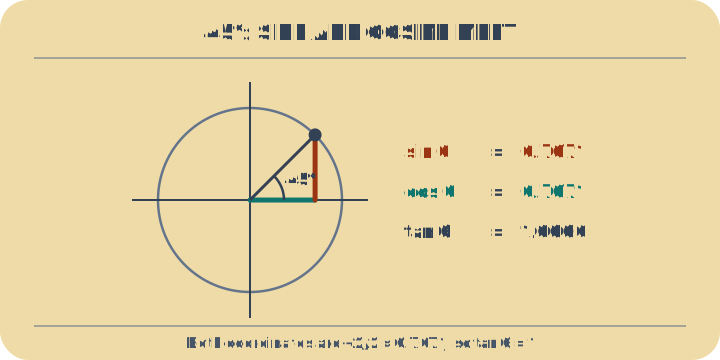
45° — the isosceles case, where sine and cosine are equal. The 45° point sits exactly on the diagonal, so both coordinates equal √2/2. Half of a right angle. The point sits on the diagonal y = x, so both coordinates have to be the same and tan θ = 1.
The 45° point sits exactly on the diagonal, so both coordinates equal √2/2.

02

30° and 60° — two readings of the same triangle

What you know: Half an equilateral triangle has sides 1, 1/2 and √3/2. Which length is the sine and which the cosine depends only on which acute angle you stand at.

Values: sinθ = cos(90° − θ)

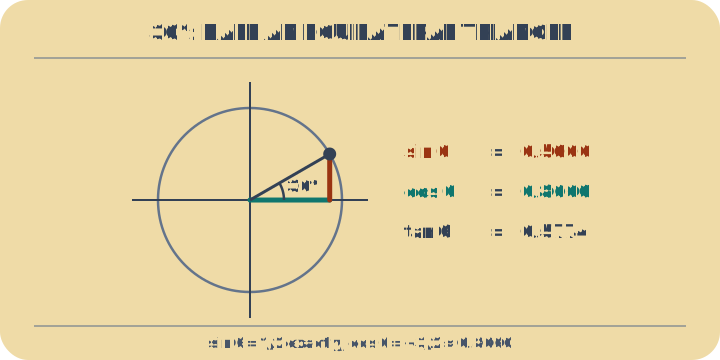
Worked example: θ = 30° → sin θ = 1/2 = 0.5, cos θ = √3/2 ≈ 0.8660, tan θ = 1/√3 ≈ 0.5774. At 60° the first two swap places.

Open this case: 30°
30° and 60° — two readings of the same triangle. The 30° point is low and far to the right; at 60° the same two lengths trade places. Half an equilateral triangle has sides 1, 1/2 and √3/2. Which length is the sine and which the cosine depends only on which acute angle you stand at.
The 30° point is low and far to the right; at 60° the same two lengths trade places.

03

On an axis — one coordinate is zero and the tangent breaks

What you know: The quadrantal angles 0°, 90°, 180° and 270° put the point on an axis, so one of the two coordinates is exactly zero.

Values: cosθ = 0 ⇒ tanθ → ±∞

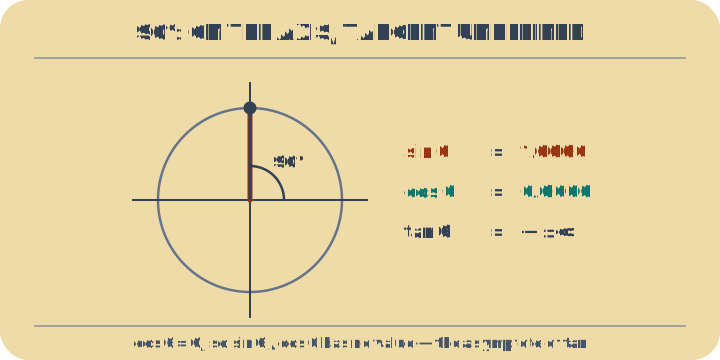
Worked example: θ = 90° → sin θ = 1, cos θ = 0, and tan θ = sin θ / cos θ has no value at all

Open this case: 90°
On an axis — one coordinate is zero and the tangent breaks. At 90° the point is at the top of the circle: height 1, width 0, and no tangent. The quadrantal angles 0°, 90°, 180° and 270° put the point on an axis, so one of the two coordinates is exactly zero.
At 90° the point is at the top of the circle: height 1, width 0, and no tangent.

04

Past the first quarter — the sizes repeat, only the signs change

What you know: Beyond 90° the coordinates keep the sizes they had at the reference angle back to the horizontal axis. The quadrant decides which of them are negative.

Values: ±f(θ′), θ′ = θ − 180°

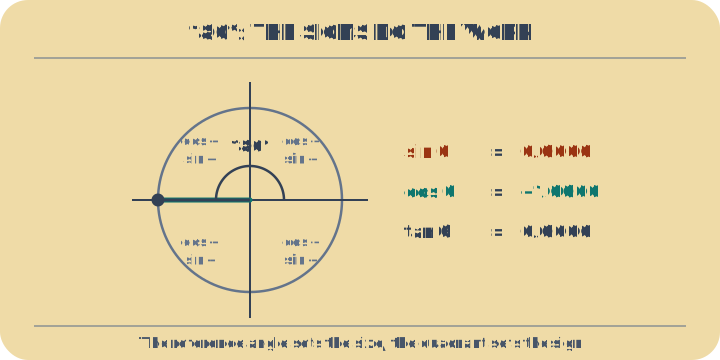
Worked example: θ = 180° → sin θ = 0, cos θ = −1. And sin 210° = −sin 30° = −0.5, because 210° has reference angle 30° and lies in the third quadrant.

Open this case: 180°
Past the first quarter — the sizes repeat, only the signs change. Half a turn puts the point at (−1, 0); the signs each quadrant gives are marked around the circle. Beyond 90° the coordinates keep the sizes they had at the reference angle back to the horizontal axis. The quadrant decides which of them are negative.
Half a turn puts the point at (−1, 0); the signs each quadrant gives are marked around the circle.

Problem solved in full

  1. A floor under π using nothing but the sine printed at 45° 5 steps

    Put a floor under π using nothing but the sine printed at 45°. This is the default state, θ = 45°, the isosceles case where sine and cosine are equal.

    1. 45° bisects the first quadrant, so the point lands on the line y = x and the two coordinates cannot differ. The circle equation is then left with one unknown.

      x=y,  x2+y2=1 ⇒ 2x2=1 ⇒ sin⁡45∘=cos⁡45∘=22=0.7071x=y,\ \ x^2+y^2=1\ \Rightarrow\ 2x^2=1\ \Rightarrow\ \sin45^\circ=\cos45^\circ=\frac{\sqrt2}{2}=0.7071
    2. The identity row is that circle equation rearranged, and 45° is the only angle in the first quadrant that splits it into two equal halves. It is also the only one where the tangent, a ratio of two equal numbers, is exactly 1.

      sin⁡2θ+cos⁡2θ=0.5000+0.5000=1,tan⁡45∘=0.70710.7071=1.0000\sin^2\theta+\cos^2\theta=0.5000+0.5000=1,\qquad \tan45^\circ=\frac{0.7071}{0.7071}=1.0000
    3. A regular octagon inscribed in the circle is eight identical triangles meeting at the centre, each with two sides of length 1 and a 45° angle between them. The area of such a triangle is ½ab sin C, so the sine already on the screen is the only quantity the octagon needs.

      A8=8⋅12⋅1⋅1⋅sin⁡45∘=4×0.70711=2.82843A_8=8\cdot\tfrac12\cdot1\cdot1\cdot\sin45^\circ=4\times0.70711=2.82843
    4. The unit circle has area π, so the ratio of the two areas says how much of the circle the octagon captures. Eight sides leaves a tenth of it outside.

      A8π=2.828433.14159=0.9003\frac{A_8}{\pi}=\frac{2.82843}{3.14159}=0.9003
    5. Doubling the number of sides needs the sine of half the angle, and the half-angle formula gets that from the cosine already printed. The same ½ab sin C then handles the sixteen-sided figure.

      sin⁡22.5∘=1−cos⁡45∘2=0.146447=0.38268 ⇒ A16=8sin⁡22.5∘=3.06147\sin22.5^\circ=\sqrt{\frac{1-\cos45^\circ}{2}}=\sqrt{0.146447}=0.38268\ \Rightarrow\ A_{16}=8\sin22.5^\circ=3.06147

    Answer

    The tool prints sin 45° = cos 45° = 0.7071, tan 45° = 1.0000 and the identity as 0.5000 + 0.5000 = 1. Those four decimals carry the octagon to 2.8284 and, after one halving of the angle, the 16-gon to 3.0615. Both are floors rather than estimates: a polygon drawn inside the circle cannot enclose more area than the circle does. Keep doubling and the shortfall shrinks by a factor of about 4 each time — 9.97%, 2.55%, 0.64%, 0.16% — so a 96-sided polygon — the count Archimedes himself worked to — gives 3.1394 by this area method, correct to two decimal places and no further. That factor of 4 is why the method was eventually abandoned: each extra correct digit costs roughly two more doublings, and every doubling is another square root taken by hand.

    An=n2sin⁡360∘n↗π:A8=2.8284, A16=3.0615, A32=3.1214, A96=3.1394A_n=\frac{n}{2}\sin\frac{360^\circ}{n}\nearrow\pi:\quad A_8=2.8284,\ A_{16}=3.0615,\ A_{32}=3.1214,\ A_{96}=3.1394

Learning path

The triangle rules, and where they come from

References (3)