RC Circuit Simulator

See how a resistor-capacitor circuit charges and discharges exponentially with time constant τ = RC.

Loading interactive simulation...

Supply voltage sets the height, never the timing

τ = RC contains no V, and that is easy to miss. Fix R and C, then change the supply from 5 V to 12 V: the curve grows taller and every voltage readout scales with it, but the time to reach 63.2% of the final value does not shift by a millisecond. On the charge preset — 10 kΩ with 100 µF — τ = 1 s at any supply voltage; the fast preset gets there in 0.01 s only because it changes R and C, not because 12 V pushes harder. The exponential is always the same shape when measured in units of τ: 63.2% at 1τ, 99.3% at 5τ. The supply voltage only labels the axis.

A capacitor is a bucket on a narrow tap

Think of the capacitor as a small reservoir and the resistor as a narrow tap feeding it. Early on the reservoir is empty, so charge rushes in and the curve climbs steeply; as it fills, the "pressure gap" shrinks and the flow eases, flattening the curve. The whole story is set by one number, τ = RC in seconds: make the resistor or the capacitor bigger and everything slows down in proportion.

Your neurons are RC circuits too

The very same equation runs inside your head. A neuron's cell membrane stores charge like a capacitor while ion channels leak it like a resistor, giving a membrane time constant τm = Rm Cm of roughly 10–20 ms. That number decides how long an incoming signal lingers before fading — and therefore whether two inputs arriving close together add up enough to fire the neuron. Brains literally compute using RC charging curves.

RC CIRCUITS — WHICH DIRECTION, AND HOW LONG IS ONE TIME CONSTANT?

Which RC Case Are You In?

Only two things decide the answer. First the direction: charging climbs towards the supply as V₀(1 − e^(−t/τ)), discharging falls away from it as V₀e^(−t/τ). Second the time constant τ = RC, which is the only clock in the circuit. Change R or C and nothing about the shape changes — only how fast the same curve is traced out.

Charging — 63% of the way there after one time constant V = V₀(1 − e−t/τ)
Discharging — the same curve upside down V = V₀e−t/τ
A small τ — the same shape, traced in milliseconds τ = RC = 10 ms
A large τ — the same shape again, now over minutes τ = RC = 100 s

01

Charging — 63% of the way there after one time constant

What you know: The capacitor starts empty and fills towards the supply voltage. V(t) = V₀(1 − e^(−t/τ)), approaching V₀ but never quite arriving.

Response: V = V₀(1 − e−t/τ)

Worked example: R = 10 kΩ with C = 100 µF → τ = 1 s. From 5 V: 3.161 V at one τ, 4.751 V at three, 4.966 V at five.

Open this case: Charging
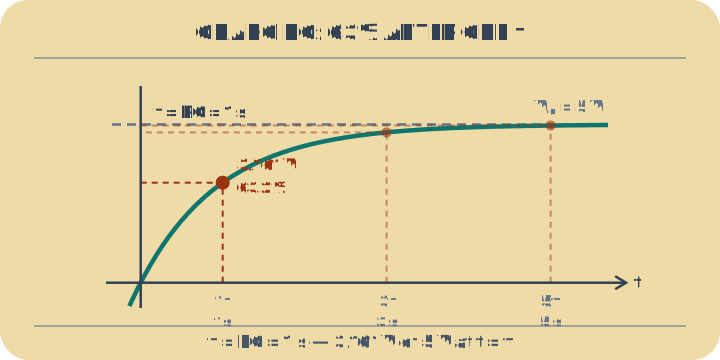
Charging — 63% of the way there after one time constant. The curve rises fast at first and then flattens, crossing 63% at exactly one time constant. The capacitor starts empty and fills towards the supply voltage. V(t) = V₀(1 − e^(−t/τ)), approaching V₀ but never quite arriving.
The curve rises fast at first and then flattens, crossing 63% at exactly one time constant.

02

Discharging — the same curve upside down

What you know: The capacitor starts charged and empties through the resistor. V(t) = V₀e^(−t/τ), with the same τ as when it filled.

Response: V = V₀e−t/τ

Worked example: The same R and C from 5 V: 1.839 V at one τ, 0.249 V at three, 0.034 V at five.

Open this case: Discharging
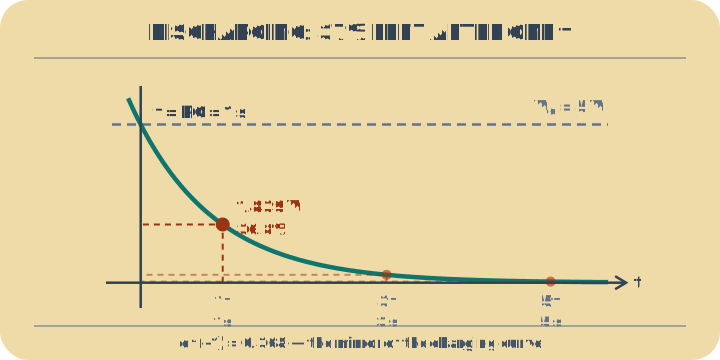
Discharging — the same curve upside down. From full, the voltage falls to 37% in one time constant and keeps halving away. The capacitor starts charged and empties through the resistor. V(t) = V₀e^(−t/τ), with the same τ as when it filled.
From full, the voltage falls to 37% in one time constant and keeps halving away.

03

A small τ — the same shape, traced in milliseconds

What you know: Reducing either R or C shortens the time constant. The curve is identical; only the numbers on the time axis change.

Response: τ = RC = 10 ms

Worked example: R = 1 kΩ with C = 10 µF → τ = 10 ms. From 12 V the capacitor is at 7.585 V after 10 ms and 11.919 V after 50 ms.

Open this case: Fast RC
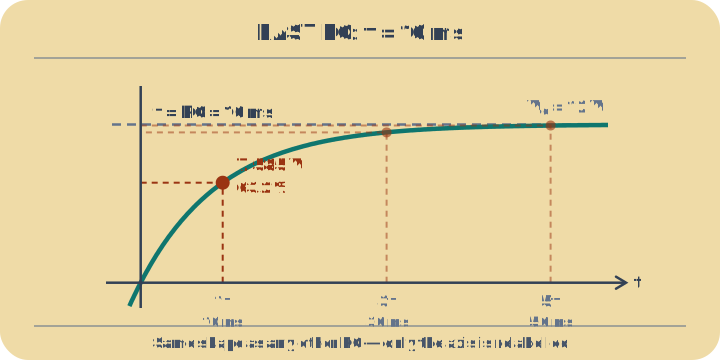
A small τ — the same shape, traced in milliseconds. Ten milliseconds per time constant, but the curve is the one from the charging case. Reducing either R or C shortens the time constant. The curve is identical; only the numbers on the time axis change.
Ten milliseconds per time constant, but the curve is the one from the charging case.

04

A large τ — the same shape again, now over minutes

What you know: Increasing R or C stretches the time constant. Ten thousand times slower than the fast case, and still exactly the same curve.

Response: τ = RC = 100 s

Worked example: R = 100 kΩ with C = 1 mF → τ = 100 s. From 9 V the capacitor reaches 5.689 V after 100 s and needs about 500 s to be considered full.

Open this case: Slow RC
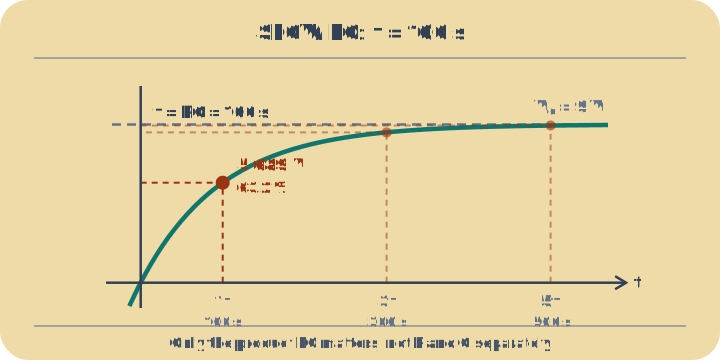
A large τ — the same shape again, now over minutes. A hundred seconds per time constant: the same curve stretched across the axis. Increasing R or C stretches the time constant. Ten thousand times slower than the fast case, and still exactly the same curve.
A hundred seconds per time constant: the same curve stretched across the axis.
References (2)

Problem solved in full

  1. A 100 μF capacitor charging through 10 kΩ from a 5 V supply 5 steps

    A 100 μF capacitor charges through 10 kΩ from a 5 V supply. Find when it crosses the two-thirds mark that a 555 timer trips at, and then find how much of the supply's energy the resistor turns into heat getting there. This is Charging with R = 10 kΩ, C = 100 μF and V₀ = 5 V.

    1. An ohm times a farad is a second, which is worth checking once by hand rather than accepting. Nothing else in this circuit has units of time, so that product is the only clock available.

      τ=RC=104 Ω×10−4 F=1.00 s\tau=RC=10^{4}\ \Omega\times10^{-4}\ \mathrm{F}=1.00\ \mathrm{s}
    2. Because the exponent is t/τ, the fractions 0.632, 0.950 and 0.993 belong to every RC circuit ever built. Only the voltage they multiply, and the length of one tick, are yours.

      V(t)=V0(1−e−t/τ):V(τ)=5(1−e−1)=3.161 V,V(3τ)=4.751 V,V(5τ)=4.966 VV(t)=V_0\left(1-e^{-t/\tau}\right):\quad V(\tau)=5(1-e^{-1})=3.161\ \mathrm{V},\quad V(3\tau)=4.751\ \mathrm{V},\quad V(5\tau)=4.966\ \mathrm{V}
    3. A 555 timer never waits for "charged" — it compares the capacitor against two thirds of the supply and fires the instant it wins. So invert the charging law for the time at a chosen voltage. One time constant is not enough: 3.161 V is still short of the 3.333 V threshold, and the extra 0.099 s is why the trip point sits at ln 3 rather than at 1.

      t=−τln⁡ ⁣(1−VV0);V=23V0 ⟹ t=τln⁡3=1.099 st=-\tau\ln\!\left(1-\frac{V}{V_0}\right);\qquad V=\tfrac23V_0\ \Longrightarrow\ t=\tau\ln3=1.099\ \mathrm{s}
    4. Now count charge instead of volts. Every coulomb that ends up on the capacitor left the supply at the full 5 V, whatever the capacitor happened to be sitting at that moment, so the supply pays QV₀. The capacitor's own store is half of that, because its voltage averaged V₀/2 while it filled.

      Q=CV0=5×10⁻⁴ C,W=QV0=CV02=2.5 mJ,EC=12CV02=1.25 mJQ=CV_0=5\times10^{-4}\ \mathrm{C},\qquad W=QV_0=CV_0^{2}=2.5\ \mathrm{mJ}, \qquad E_C=\tfrac12CV_0^{2}=1.25\ \mathrm{mJ}
    5. The missing half went somewhere, and there is only one other component. Integrating the resistor's heating over the whole charge confirms the figure — and watch what happens to R: it divides the current and multiplies τ, so it cancels out completely.

      ER=∫0∞ ⁣i2R dt=V02R∫0∞ ⁣e−2t/τdt=V02R⋅τ2=12CV02=1.25 mJE_R=\int_0^{\infty}\!i^{2}R\,dt=\frac{V_0^{2}}{R}\int_0^{\infty}\!e^{-2t/\tau}dt =\frac{V_0^{2}}{R}\cdot\frac{\tau}{2}=\tfrac12CV_0^{2}=1.25\ \mathrm{mJ}

    Answer

    The tool prints τ = 1.00 s, and 3.161 V, 4.751 V and 4.966 V at one, three and five time constants. Step 5 is the one to keep. Halve the resistor and the capacitor fills in half a second instead of one, and dissipates exactly the same 1.25 mJ, because the heat is fixed by C and V₀ alone. A resistor-fed capacitor is therefore 50% efficient however it is designed, which is why no efficient charger uses one: an inductor and a switch move the same charge without a fixed voltage drop standing in the way. The same 50% is why charging a large capacitor bank through a resistor is a heat problem before it is an electrical one.

    ER=EC=12CV02∀ R>0E_R=E_C=\tfrac12CV_0^{2}\quad\forall\,R>0

Learning path

Resistance, then reactance

Further reading (2)