Kinematics (SUVAT) Calculator

solve the equations of motion — enter any 3, find the other 2

Velocity changes by a every second v=u+atv=u+at
Displacement: the area under the velocity–time line s=ut+12at2,s=vt−12at2s=12(u+v) t\begin{gathered}s=ut+\tfrac12at^{2},\qquad s=vt-\tfrac12at^{2}\\ s=\tfrac12(u+v)\,t\end{gathered}
Without the time v2=u2+2asv^{2}=u^{2}+2as
Loading interactive simulation...

Lesson

The theory — Kinematics (SUVAT) Calculator

With constant acceleration, five quantities describe a stretch of straight-line motion: the displacement s, the initial velocity u, the final velocity v, the acceleration a and the time t. Three of them usually fix the other two. The exception is solving for t from s, u and a: that is a quadratic, so a ball thrown up can pass a height twice, or never reach it.

What each symbol means

s
displacement along the line from the starting point, with a sign; not the distance travelled
u
velocity at the start of the interval
v
velocity at the end of the interval
a
acceleration, the same at every moment of the interval
t
duration of the interval

Where the formula comes from

  1. Constant acceleration means the velocity changes by the same amount every second. After t seconds it has changed by at. On the graph above that is a straight line with slope a.
    v=u+atv=u+at
  2. Displacement is the area under the velocity–time line. That area is a trapezium with parallel sides u and v and width t.
    s=12(u+v) ts=\tfrac12(u+v)\,t
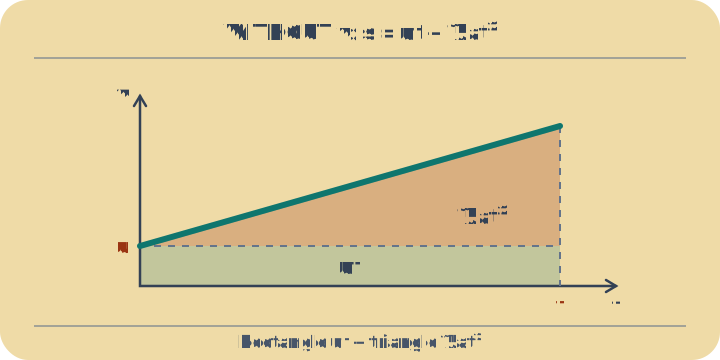
  3. Put the first equation into the second and v disappears. The rectangle ut is the distance at the starting speed; the triangle ½at² is what the acceleration adds.
    s=12(u+(u+at)) t=ut+12at2s=\tfrac12\bigl(u+(u+at)\bigr)\,t=ut+\tfrac12at^{2}
  4. Eliminate t instead. Step 1 gives t = (v − u)/a, and putting that into step 2 leaves no time at all. Because v appears squared, this equation can return two velocities.
    s=12(u+v)⋅v−ua=v2−u22a ⇒ v2=u2+2ass=\tfrac12(u+v)\cdot\frac{v-u}{a}=\frac{v^{2}-u^{2}}{2a}\ \Rightarrow\ v^{2}=u^{2}+2as
  5. Choose a positive direction before writing a number. s, u, v and a each carry a sign along the line; t never does. With up as positive, gravity is a = −9.81 m/s².
    ↑+:a=−g=−9.81 m/s2\uparrow{+}:\quad a=-g=-9{.}81\ \mathrm{m/s^{2}}
Assumes
The acceleration is the same throughout the interval and the motion stays on one straight line. A journey whose acceleration changes is split into stages, each with its own five quantities (problem 8).
why 5 letters, only 2 equations?

The five SUVAT letters look like five independent facts, but they aren't. Every SUVAT equation is just v=u+at and s=ut+½at² rearranged — the other three (s=(u+v)/2·t, v²=u²+2as, s=vt-½at²) fall straight out of substituting one into the other. That's why 3 knowns pin down the other 2: you're only ever solving 2 equations in 2 unknowns. Only once can it fail: with t unknown in s=ut+½at², the quadratic can give two times, as ball passes twice shows, or none.

Galileo's odd-number rule

Long before calculus, Galileo noticed that an object accelerating from rest covers distances in the ratio 1 : 3 : 5 : 7 across equal time intervals — always the odd numbers. Add them up and the totals are 1, 4, 9, 16, i.e. the squares, which is exactly why s = ½at². He published it in 1638 from balls rolled down ramps, half a century before Newton's Principia.

KINEMATICS THEORY — THE FIVE EQUATIONS OF MOTION

Choosing a SUVAT Equation: Which Letter Is Missing?

Constant acceleration ties five quantities together — displacement s, initial velocity u, final velocity v, acceleration a and time t. Every problem hands you three of them and asks for a fourth. Each equation below leaves exactly one letter out, so the one you want is the one that omits the quantity you neither know nor need.

Without s — uses v, u, a, t v = u + at
Without v — uses s, u, a, t s = ut + ½at2
Without a — uses s, u, v, t s = ½(u + v)t
Without t — uses s, u, v, a v2 = u2 + 2as
Without u — uses s, v, a, t s = vt − ½at2

01

Without s — uses v, u, a, t

What you know: Three of initial velocity u, final velocity v, acceleration a and time t. Displacement never appears.

Equation: v = u + at

Worked example: u = 25 m/s, v = 0, t = 5 s → a = (0 − 25) / 5 = −5 m/s²

Open this case: braking to a stop
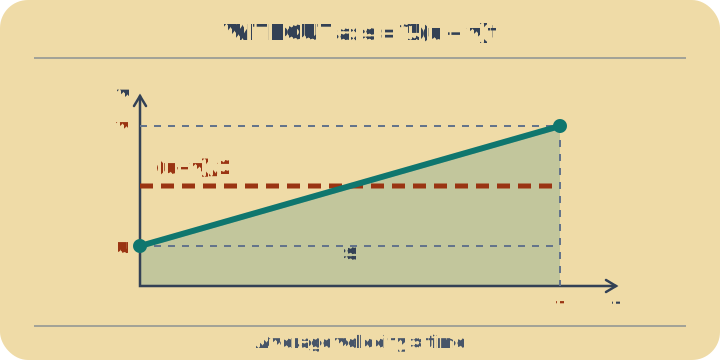
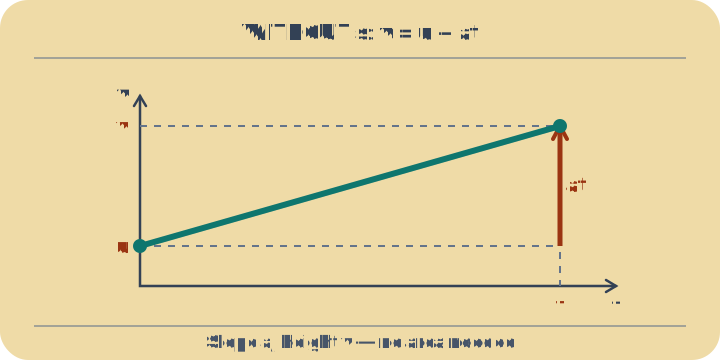
Without s — uses v, u, a, t. Velocity–time graph: v is the height of the line after time t. Displacement plays no part. Three of initial velocity u, final velocity v, acceleration a and time t. Displacement never appears.
Velocity–time graph: v is the height of the line after time t. Displacement plays no part.

02

Without v — uses s, u, a, t

What you know: Initial velocity u, acceleration a and time t. You want the distance covered, not the speed at the end.

Equation: s = ut + ½at2

Worked example: u = 0, a = 9.81 m/s², t = 3 s → s = 0 + ½ · 9.81 · 3² = 44.1 m

Open this case: dropped from rest
Without v — uses s, u, a, t. Area under the line splits into a rectangle ut plus a triangle ½at². Initial velocity u, acceleration a and time t. You want the distance covered, not the speed at the end.
Area under the line splits into a rectangle ut plus a triangle ½at².

03

Without a — uses s, u, v, t

What you know: Starting speed u, final speed v and time t. The acceleration is unknown, or simply beside the point.

Equation: s = ½(u + v)t

Worked example: u = v = 12 m/s, t = 6 s → s = ½(12 + 12) · 6 = 72 m

Open this case: constant velocity
Without a — uses s, u, v, t. Trapezium area: the mean of u and v, multiplied by t. Starting speed u, final speed v and time t. The acceleration is unknown, or simply beside the point.
Trapezium area: the mean of u and v, multiplied by t.

04

Without t — uses s, u, v, a

What you know: Displacement s, one of the two velocities, and the acceleration. The clock is never started.

Equation: v2 = u2 + 2as

Worked example: s = 5 m, u = 15 m/s, a = −9.81 m/s² → v² = 225 − 98.1, so v = ±11.3 m/s

Open this case: ball passes twice
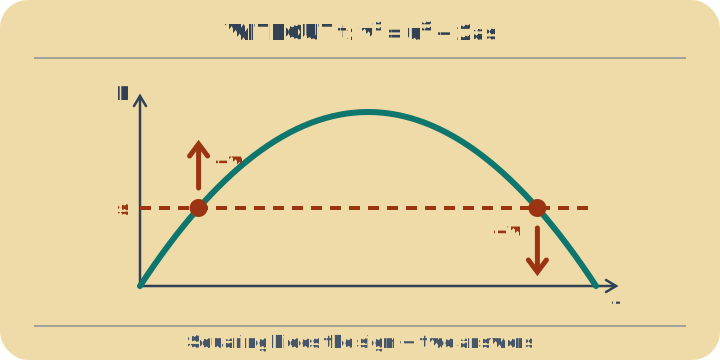
Without t — uses s, u, v, a. Same height, two velocities: the ± is the way up and the way down. Displacement s, one of the two velocities, and the acceleration. The clock is never started.
Same height, two velocities: the ± is the way up and the way down.

05

Without u — uses s, v, a, t

What you know: Final velocity v, acceleration a and time t. The starting speed is unknown and you do not need it.

Equation: s = vt − ½at2

Worked example: v = 0, a = −3 m/s², t = 25 s → s = 0 − ½(−3)(25²) = 937.5 m

Open this case: runway rollout
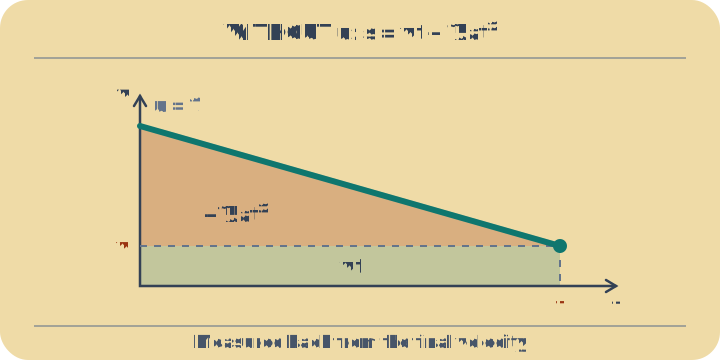
Without u — uses s, v, a, t. Working back from the end: vt minus the slice the deceleration removed. Final velocity v, acceleration a and time t. The starting speed is unknown and you do not need it.
Working back from the end: vt minus the slice the deceleration removed.
References (1)
  • Insight block 3 — the odd-number rule, and the ramps it came from: G. Galilei, Discorsi e dimostrazioni matematiche intorno a due nuove scienze. Leiden, 1638, Third Day — distances in the ratio 1 : 3 : 5 : 7 over equal times, which sum to the squares.

Problems solved in full

  1. A car starting at 5 m/s and accelerating at 2 m/s² 5 steps

    A car starts at 5 m/s and accelerates at 2 m/s² for 4 seconds. Find how fast and how far — then find when it passes the halfway point, which is not at the halfway time.

    Open this problem in the tool

    1. Velocity first, because it is the definition of acceleration rearranged: the speed gained is the rate times the duration.

      v=u+at=5+2(4)=13 m/sv=u+at=5+2(4)=13\ \mathrm{m/s}
    2. Displacement is the starting speed carried for four seconds, plus what the acceleration adds. The two terms are 20 m and 16 m, and neither dominates yet.

      s=ut+12at2=5(4)+12(2)(16)=20+16=36 ms=ut+\tfrac12at^2=5(4)+\tfrac12(2)(16)=20+16=36\ \mathrm{m}
    3. Now check with the equation that has no time in it. It returns 169 on both sides, which is not a new fact — it is the first two equations with t eliminated, so agreement is guaranteed and disagreement would mean arithmetic error.

      v2=u2+2as:169=25+2(2)(36)=25+144=169 ✓v^2=u^2+2as:\quad 169=25+2(2)(36)=25+144=169\ \checkmark
    4. The average velocity is the mean of the endpoints, and only because the acceleration is constant. Multiply by the time and the displacement comes out again.

      vˉ=u+v2=5+132=9 m/s,9×4=36 m\bar v=\frac{u+v}{2}=\frac{5+13}{2}=9\ \mathrm{m/s},\qquad 9\times4=36\ \mathrm{m}
    5. Now the halfway point. Half the distance is 18 m, and solving the quadratic puts it at 2.424 s — not 2 s. At t = 2 s the car has covered only 14 m of the 36.

      5t+t2=18⟹t=−5+972=2.424 s5t+t^2=18\quad\Longrightarrow\quad t=\frac{-5+\sqrt{97}}{2}=2.424\ \mathrm{s}

    Answer

    The tool prints s = 36 m and v = 13 m/s. Step 5 is the one worth carrying: under acceleration, half the time and half the distance are different moments, and the second half of any accelerating journey is always the quicker one. This is why an overtake feels wrong when it is planned by distance — the gap you can see closes in the time you have left, not in the space. Step 3 is the other half of the lesson: there are five SUVAT equations and two independent facts, so a third equation can confirm your arithmetic and can never add information.

    t=2 s→s=14 m;s=18 m→t=2.424 st=2\ \mathrm{s}\to s=14\ \mathrm{m};\qquad s=18\ \mathrm{m}\to t=2{.}424\ \mathrm{s}
  2. Stopping in a known distance 4 steps

    A car travelling at 20 m/s brakes uniformly and stops in 50 m. Find its acceleration and how long it takes to stop.

    Open this problem in the tool

    Show solution
    1. Take the direction of travel as positive and list the five. Stopping means v = 0. The time is unknown, so start with the equation that has no t in it:

      s=50 m,u=20 m/s,v=0,a=?,t=?s=50\ \mathrm{m},\quad u=20\ \mathrm{m/s},\quad v=0,\quad a=?,\quad t=?
    2. Solve v² = u² + 2as for a:

      a=v2−u22s=0−2022(50)=−4 m/s2a=\frac{v^{2}-u^{2}}{2s}=\frac{0-20^{2}}{2(50)}=-4\ \mathrm{m/s^{2}}
    3. The time comes from the average velocity, which needs no acceleration at all:

      t=2su+v=2(50)20+0=5 st=\frac{2s}{u+v}=\frac{2(50)}{20+0}=5\ \mathrm{s}
    4. Check with the definition of acceleration:

      v=u+at=20+(−4)(5)=0 ✓v=u+at=20+(-4)(5)=0\ \checkmark

    Answer

    a = −4 m/s², t = 5 s. The minus sign says the acceleration points against the motion. With the same brakes at 40 m/s, v² = u² + 2as gives 200 m, four times as far: stopping distance grows with the square of the speed.

    a=−4 m/s2,t=5 sa=-4\ \mathrm{m/s^{2}},\qquad t=5\ \mathrm{s}
  3. From rest, over a known distance and time 3 steps

    A sprinter starts from rest and covers the first 20 m in 3.2 s with constant acceleration. Find the acceleration and the speed at the 20 m mark.

    Open this problem in the tool

    Show solution
    1. List the five. From rest means u = 0, and v is not wanted yet, so use the equation without v:

      s=20 m,u=0,t=3.2 s,a=?,v=?s=20\ \mathrm{m},\quad u=0,\quad t=3{.}2\ \mathrm{s},\quad a=?,\quad v=?
    2. Solve s = ut + ½at² for a:

      s=ut+12at2 ⇒ a=2(s−ut)t2=2(20−0)3.22=3.906 m/s2s=ut+\tfrac12at^{2}\ \Rightarrow\ a=\frac{2(s-ut)}{t^{2}}=\frac{2(20-0)}{3{.}2^{2}}=3{.}906\ \mathrm{m/s^{2}}
    3. Then the speed, from the definition of acceleration:

      v=u+at=0+3.906×3.2=12.5 m/sv=u+at=0+3{.}906\times3{.}2=12{.}5\ \mathrm{m/s}

    Answer

    a = 3.906 m/s², v = 12.5 m/s. The final speed is exactly twice the average speed, 20/3.2 = 6.25 m/s, as it is for every start from rest: the average of 0 and v is v/2.

    a=3.906 m/s2,v=12.5 m/sa=3{.}906\ \mathrm{m/s^{2}},\qquad v=12{.}5\ \mathrm{m/s}
  4. Thrown straight up: the top of the flight 4 steps

    A ball is thrown straight up at 14 m/s. How high does it rise above the launch point, and how long does it take to get there? Ignore air resistance.

    Open this problem in the tool

    Show solution
    1. Take up as positive, so gravity is a = −9.81 m/s². At the top the ball is momentarily at rest, and that is the third known: v = 0.

      u=14 m/s,v=0,a=−9.81 m/s2,s=?,t=?u=14\ \mathrm{m/s},\quad v=0,\quad a=-9{.}81\ \mathrm{m/s^{2}},\quad s=?,\quad t=?
    2. The time comes from the definition of acceleration:

      t=v−ua=0−14−9.81=1.427 st=\frac{v-u}{a}=\frac{0-14}{-9{.}81}=1{.}427\ \mathrm{s}
    3. The height is the average velocity, half of 14 m/s, times that time:

      s=12(u+v) t=12(14+0)(1.427)=9.99 ms=\tfrac12(u+v)\,t=\tfrac12(14+0)(1{.}427)=9{.}99\ \mathrm{m}
    4. Check with the equation that has no time in it:

      v2=u2+2as:0=142+2(−9.81) s ⇒ s=19619.62=9.99 m ✓v^{2}=u^{2}+2as:\quad 0=14^{2}+2(-9{.}81)\,s\ \Rightarrow\ s=\frac{196}{19{.}62}=9{.}99\ \mathrm{m}\ \checkmark

    Answer

    9.99 m above the launch point, reached after 1.427 s. At the top the velocity is zero and the acceleration is not. It is −9.81 m/s² there as everywhere else on the flight, which is why the ball comes back down.

    s=9.99 m,t=1.427 ss=9{.}99\ \mathrm{m},\qquad t=1{.}427\ \mathrm{s}
  5. One height, passed twice 3 steps

    A ball is thrown straight up at 15 m/s. When is it 5.0 m above the launch point, and how fast is it moving each time?

    Open this problem in the tool

    Show solution
    1. Up is positive: s = 5.0, u = 15, a = −9.81, and v and t are wanted. Start with the equation without t:

      v2=u2+2as=152+2(−9.81)(5.0)=126.9v^{2}=u^{2}+2as=15^{2}+2(-9{.}81)(5{.}0)=126{.}9
    2. A square root has two signs, and here both are real: +11.26 m/s on the way up and −11.26 m/s on the way down.

      v=±126.9=±11.26 m/sv=\pm\sqrt{126{.}9}=\pm11{.}26\ \mathrm{m/s}
    3. Each velocity gives its own time:

      t=v−ua:11.26−15−9.81=0.3807 s,−11.26−15−9.81=2.677 st=\frac{v-u}{a}:\qquad\frac{11{.}26-15}{-9{.}81}=0{.}3807\ \mathrm{s},\qquad\frac{-11{.}26-15}{-9{.}81}=2{.}677\ \mathrm{s}

    Answer

    At 0.3807 s, rising at 11.26 m/s, and at 2.677 s, falling at 11.26 m/s. The two times sit symmetrically about the top of the flight at 15/9.81 = 1.529 s, and the speeds are equal: falling, the ball passes each height at the speed it had there on the way up. Press ball passes twice to see both lines on the graph.

    t=0.3807 s (v=+11.26),t=2.677 s (v=−11.26)t=0{.}3807\ \mathrm{s}\ (v=+11{.}26),\qquad t=2{.}677\ \mathrm{s}\ (v=-11{.}26)
  6. Off a cliff: a root to throw away 4 steps

    A stone is thrown upwards at 10 m/s from the edge of a cliff 45 m high and lands at the foot of the cliff. How long is it in the air, and how fast is it moving when it lands?

    Open this problem in the tool

    Show solution
    1. Up is positive and displacement is measured from the launch point. The foot of the cliff is below the start, so s is negative:

      s=−45 m,u=10 m/s,a=−9.81 m/s2,v=?,t=?s=-45\ \mathrm{m},\quad u=10\ \mathrm{m/s},\quad a=-9{.}81\ \mathrm{m/s^{2}},\quad v=?,\quad t=?
    2. The velocity first, from the equation without t. The stone is falling when it lands, so take the negative root:

      v=−u2+2as=−102+2(−9.81)(−45)=−982.9=−31.35 m/sv=-\sqrt{u^{2}+2as}=-\sqrt{10^{2}+2(-9{.}81)(-45)}=-\sqrt{982{.}9}=-31{.}35\ \mathrm{m/s}
    3. Then the time:

      t=v−ua=−31.35−10−9.81=4.215 st=\frac{v-u}{a}=\frac{-31{.}35-10}{-9{.}81}=4{.}215\ \mathrm{s}
    4. Solving s = ut + ½at² for t directly gives a quadratic with two roots. The negative one is a moment before the throw, when a stone on the same parabola would have been leaving the ground. It is not part of this problem:

      −45=10t−4.905t2 ⇒ t=10±982.99.81:t=4.215,t=−2.176-45=10t-4{.}905t^{2}\ \Rightarrow\ t=\frac{10\pm\sqrt{982{.}9}}{9{.}81}:\qquad t=4{.}215,\quad t=-2{.}176

    Answer

    4.215 s in the air, landing at 31.35 m/s downwards. Write s = +45 with up still positive and the page reports no real solution, and it is right: thrown at 10 m/s, the stone never gets 45 m above the edge.

    t=4.215 s,v=−31.35 m/st=4{.}215\ \mathrm{s},\qquad v=-31{.}35\ \mathrm{m/s}
  7. A chase: two motions on one clock 3 steps

    A car waits at a traffic light. As the light turns green it accelerates at 3.0 m/s², and at that moment a truck passes it at a steady 15 m/s. When and where does the car catch the truck, and how fast is the car going then?

    Open this problem in the tool

    Show solution
    1. The two motions share one clock and one starting line. Write the displacement of each after a time t:

      scar=12(3.0) t2,struck=15 ts_{\mathrm{car}}=\tfrac12(3{.}0)\,t^{2},\qquad s_{\mathrm{truck}}=15\,t
    2. Catching up means the same displacement at the same time:

      12(3.0) t2=15 t ⇒ t (1.5 t−15)=0 ⇒ t=0,t=10 s\tfrac12(3{.}0)\,t^{2}=15\,t\ \Rightarrow\ t\,(1{.}5\,t-15)=0\ \Rightarrow\ t=0,\quad t=10\ \mathrm{s}
    3. t = 0 is the start, when they are already side by side. At t = 10 s the car on its own is an ordinary case, with u = 0, a = 3.0 and t = 10:

      s=ut+12at2=0+12(3.0)(10)2=150 m,v=u+at=0+3.0(10)=30 m/ss=ut+\tfrac12at^{2}=0+\tfrac12(3{.}0)(10)^{2}=150\ \mathrm{m},\qquad v=u+at=0+3{.}0(10)=30\ \mathrm{m/s}

    Answer

    After 10 s, 150 m from the light, with the car at 30 m/s. That is exactly twice the truck’s speed, and from rest it always will be: over the chase the car’s average speed equals the truck’s, and from rest the average is half the final speed.

    t=10 s,s=150 m,vcar=30 m/s=2 vtruckt=10\ \mathrm{s},\qquad s=150\ \mathrm{m},\qquad v_{\mathrm{car}}=30\ \mathrm{m/s}=2\,v_{\mathrm{truck}}
  8. Three stages, read as areas 3 steps

    A train starts from rest and accelerates uniformly at 0.50 m/s² for 40 s, runs at constant speed for 2.0 minutes, then brakes uniformly to rest in 25 s. Find the total distance and the average speed for the journey.

    Show solution
    1. Three stages, each with its own five quantities. The speed at the end of the first stage is the speed of the second and the start of the third:

      v1=u+at=0+0.50(40)=20 m/sv_1=u+at=0+0{.}50(40)=20\ \mathrm{m/s}
    2. Each stage’s distance is the area under its piece of the velocity–time graph: a triangle, a rectangle and a triangle.

      s1=12(20)(40)=400,s2=20×120=2400,s3=12(20)(25)=250 ms_1=\tfrac12(20)(40)=400,\qquad s_2=20\times120=2400,\qquad s_3=\tfrac12(20)(25)=250\ \mathrm{m}
    3. Average speed is the total distance over the total time, not the mean of the speeds:

      vˉ=400+2400+25040+120+25=3050185=16.49 m/s\bar v=\frac{400+2400+250}{40+120+25}=\frac{3050}{185}=16{.}49\ \mathrm{m/s}

    Answer

    3,050 m, at an average of 16.49 m/s. The braking deceleration, 20/25 = 0.80 m/s², was never needed: a triangle’s area needs only its base and height.

    s=3050 m,vˉ=16.49 m/ss=3050\ \mathrm{m},\qquad\bar v=16{.}49\ \mathrm{m/s}

Supplementary problems, answers only

  1. A cyclist speeds up uniformly from 4.0 m/s to 10 m/s in 5.0 s. Find the acceleration and the distance covered.

    Show answer

    1.2 m/s² and 35 m.

    a=10−4.05.0=1.2 m/s2,s=12(4.0+10)(5.0)=35 ma=\frac{10-4{.}0}{5{.}0}=1{.}2\ \mathrm{m/s^{2}},\qquad s=\tfrac12(4{.}0+10)(5{.}0)=35\ \mathrm{m}
  2. An aircraft must reach 75 m/s to take off and accelerates from rest at 2.5 m/s². What is the shortest runway it can use, and how long is the take-off run?

    Show answer

    1,125 m, taking 30 s.

    s=v22a=7522(2.5)=1125 m,t=752.5=30 ss=\frac{v^{2}}{2a}=\frac{75^{2}}{2(2{.}5)}=1125\ \mathrm{m},\qquad t=\frac{75}{2{.}5}=30\ \mathrm{s}
  3. A stone dropped into a well hits the water 2.4 s later. Ignoring the time the sound takes to come back up, how far below the top is the water?

    Show answer

    28.25 m.

    s=12(9.81)(2.4)2=28.25 ms=\tfrac12(9{.}81)(2{.}4)^{2}=28{.}25\ \mathrm{m}
  4. A ball thrown straight up comes back to the thrower’s hand 3.0 s later. Find its launch speed and the greatest height it reaches.

    Show answer

    14.72 m/s and 11.04 m: by symmetry the top comes at 1.5 s.

    u=9.81×1.5=14.72 m/s,h=u22g=11.04 mu=9{.}81\times1{.}5=14{.}72\ \mathrm{m/s},\qquad h=\frac{u^{2}}{2g}=11{.}04\ \mathrm{m}
  5. A driver travelling at 30 m/s sees a hazard, reacts after 0.80 s, then brakes at 6.0 m/s². How far does the car travel from the moment the hazard appears until it stops?

    Show answer

    99 m: 24 m before the brakes go on and 75 m while braking.

    30(0.80)+3022(6.0)=24+75=99 m30(0{.}80)+\frac{30^{2}}{2(6{.}0)}=24+75=99\ \mathrm{m}
  6. A particle moving at 6.0 m/s has a constant acceleration of −2.0 m/s². At what times is it 5.0 m from its starting point?

    Show answer

    At 1.0 s and 5.0 s it is 5.0 m ahead; at 6.742 s it is 5.0 m behind.

    ±5.0=6.0 t−t2:t=1.0, 5.0;t=3+14=6.742 s\pm5{.}0=6{.}0\,t-t^{2}:\qquad t=1{.}0,\ 5{.}0;\qquad t=3+\sqrt{14}=6{.}742\ \mathrm{s}

Learning path

Throwing things