Projectile Motion Simulator

parabolic trajectory with live animation

Two motions on one clock x=v0cos⁡θ ty=h+v0sin⁡θ t−12gt2\begin{gathered}x=v_0\cos\theta\,t\\ y=h+v_0\sin\theta\,t-\tfrac12gt^{2}\end{gathered}
Launched and landing at the same height tf=2v0sin⁡θg,R=v02sin⁡2θgymax⁡=v02sin⁡2θ2g\begin{gathered}t_f=\frac{2v_0\sin\theta}{g},\qquad R=\frac{v_0^{2}\sin2\theta}{g}\\ y_{\max}=\frac{v_0^{2}\sin^{2}\theta}{2g}\end{gathered}
Loading interactive simulation...

Lesson

The theory — Projectile Motion Simulator

A projectile moves under gravity alone once it is launched. Thrown at speed v0 and angle θ from a height h, it moves sideways at a constant speed while its height changes exactly as in free fall.

What each symbol means

v₀
launch speed
θ
launch angle above the horizontal
h
launch height above the landing ground
g
acceleration due to gravity, 9.81 m/s², downwards
R
range: the horizontal distance from launch to landing

Where the formula comes from

  1. Gravity acts only downwards, so nothing changes the horizontal velocity. The horizontal distance grows at the same rate for the whole flight.
    vx=v0cos⁡θ,x=v0cos⁡θ tv_x=v_0\cos\theta,\qquad x=v_0\cos\theta\,t
  2. Vertically it is constant acceleration, the previous lesson with u = v0 sin θ and a = −g. Both motions share one clock, t.
    vy=v0sin⁡θ−gt,y=h+v0sin⁡θ t−12gt2v_y=v_0\sin\theta-gt,\qquad y=h+v_0\sin\theta\,t-\tfrac12gt^{2}
  3. Eliminate t between them and the height becomes a quadratic in the horizontal distance: the path is a parabola.
    y=h+xtan⁡θ−g x22v02cos⁡2θy=h+x\tan\theta-\frac{g\,x^{2}}{2v_0^{2}\cos^{2}\theta}
  4. The flight ends when the height returns to zero. From level ground the two roots are the launch and tf, and the range is vx carried for tf. Since sin 2θ = sin(180° − 2θ), the angles θ and 90° − θ give the same range.
    tf=2v0sin⁡θg,R=vx tf=2v02sin⁡θcos⁡θg=v02sin⁡2θgt_f=\frac{2v_0\sin\theta}{g},\qquad R=v_x\,t_f=\frac{2v_0^{2}\sin\theta\cos\theta}{g}=\frac{v_0^{2}\sin2\theta}{g}
  5. At the top the vertical velocity is zero. The equation without the time gives the height.
    0=(v0sin⁡θ)2−2g (ymax⁡−h) ⇒ ymax⁡=h+v02sin⁡2θ2g0=(v_0\sin\theta)^{2}-2g\,(y_{\max}-h)\ \Rightarrow\ y_{\max}=h+\frac{v_0^{2}\sin^{2}\theta}{2g}
Assumes
No air resistance, and g the same everywhere on the flight. With air resistance the path is no longer a parabola, which is the next page.
Two motions stacked into one

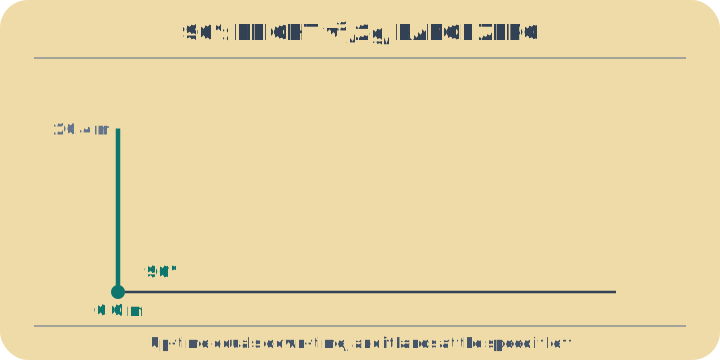
A projectile is really doing two independent things at once: drifting sideways at a steady pace while falling under gravity. Neither influences the other, which leads to a famous result — a bullet fired horizontally and one simply dropped from the same height hit the ground at the exact same moment. Set the angle to 0°, give the launch some height, and change the speed: the range grows and the time of flight does not move.

Above ground, 45° stops winning

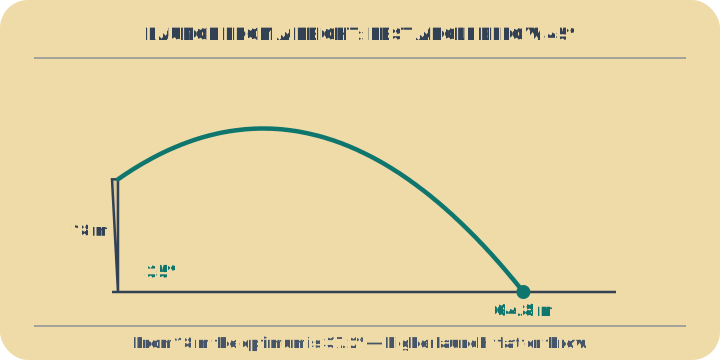
The famous 45° rule for maximum range only holds when you launch and land at the same height. Add a launch height h and the best angle drops below 45°, following θ = arctan(v / √(v² + 2gh)). Throw a ball off a cliff and aiming a little flatter than 45° actually sends it farther — raise the height slider and hunt for the true optimum.

PROJECTILES — THE ANGLE DECIDES EVERYTHING EXCEPT WHAT THE SPEED DECIDES

Which Launch Case Are You Solving?

Horizontal and vertical motion are independent: constant speed sideways, constant acceleration downwards. Everything else follows from that split. On level ground the range is R = v²sin(2θ)/g, which peaks at 45° and pairs up angles either side of it. Launch from a height and that symmetry breaks, and the best angle drops below 45°.

45° on level ground — the maximum range R = v2/g at θ = 45°
Complementary angles — two ways to hit the same spot R = v2sin(2θ)/g
Straight up — all height, no range h = v2/2g, R = 0
Launched from a height — the symmetry breaks h > 0 ⇒ θopt < 45°

01

45° on level ground — the maximum range

What you know: Launch and landing are at the same height, and you want the furthest throw. sin(2θ) is largest when 2θ = 90°.

Range: R = v2/g at θ = 45°

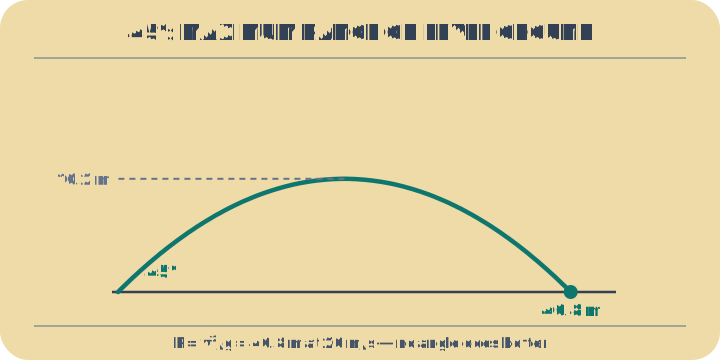
Worked example: v = 20 m/s at 45° → R = v²/g = 400/9.81 = 40.8 m, the longest this speed can reach

Open this case: 45° max range
45° on level ground — the maximum range. At 45° the hang time and the horizontal speed are balanced, and the range peaks. Launch and landing are at the same height, and you want the furthest throw. sin(2θ) is largest when 2θ = 90°.
At 45° the hang time and the horizontal speed are balanced, and the range peaks.

02

Complementary angles — two ways to hit the same spot

What you know: Any angle θ and its complement 90° − θ give the same range on level ground, because sin(2θ) = sin(180° − 2θ).

Range: R = v2sin(2θ)/g

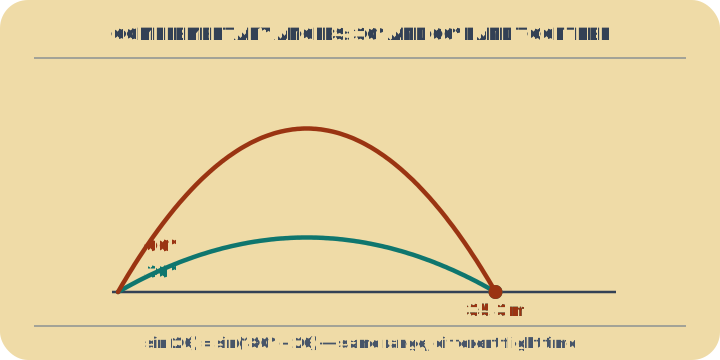
Worked example: v = 20 m/s at 30° → 35.3 m; at 60° → 35.3 m again. The flat shot takes 2.0 s, the lofted one 3.5 s

Open this case: 30°
Complementary angles — two ways to hit the same spot. Two trajectories, one landing point: 30° and 60° are the same range at different heights. Any angle θ and its complement 90° − θ give the same range on level ground, because sin(2θ) = sin(180° − 2θ).
Two trajectories, one landing point: 30° and 60° are the same range at different heights.

03

Straight up — all height, no range

What you know: θ = 90°, so the horizontal component is zero. Everything the launch gave goes into climbing and coming back.

Range: h = v2/2g, R = 0

Worked example: v = 20 m/s straight up → maximum height v²/2g = 20.4 m, range 0, and it returns to your hand at 20 m/s

Open this case: 90° straight up
Straight up — all height, no range. Vertical launch: the trajectory collapses to a line, and the range vanishes. θ = 90°, so the horizontal component is zero. Everything the launch gave goes into climbing and coming back.
Vertical launch: the trajectory collapses to a line, and the range vanishes.

04

Launched from a height — the symmetry breaks

What you know: The landing point is below the launch point, so the flight is no longer symmetric and the 45° rule no longer holds.

Range: h > 0 ⇒ θopt < 45°

Worked example: v = 22 m/s at 35° from 18 m up → 3.6 s in the air and 65 m downrange; the optimal angle here is 37.2°, not 45°

Open this case: from a cliff
Launched from a height — the symmetry breaks. Extra height buys extra flight time, so a flatter throw wins. The landing point is below the launch point, so the flight is no longer symmetric and the 45° rule no longer holds.
Extra height buys extra flight time, so a flatter throw wins.

Problems solved in full

  1. A ball launched at 20 m/s and 45° from level ground 5 steps

    A ball is launched at 20 m/s and 45° from level ground. Find how long it stays up and how far it lands — then find what a 5° aiming error costs, which is the question that decides whether 45° is worth aiming for.

    1. Split the launch into two motions that never speak to each other. Gravity acts only downwards, so the horizontal speed is the same at landing as at launch, and 45° is the one angle where the two components start out equal.

      vx=v0cos⁡θ=20cos⁡45∘=14.142 m/s,vy=v0sin⁡θ=14.142 m/sv_x=v_0\cos\theta=20\cos45^\circ=14.142\ \mathrm{m/s},\qquad v_y=v_0\sin\theta=14.142\ \mathrm{m/s}
    2. The flight ends when the height comes back to zero, and only the vertical motion knows anything about that. Rise and fall take the same time from level ground, so the whole flight is twice the time to the top.

      y(tf)=0:tf=2vyg=2(14.142)9.81=2.8832 sy(t_f)=0:\quad t_f=\frac{2v_y}{g}=\frac{2(14.142)}{9.81}=2.8832\ \mathrm{s}
    3. Horizontal distance is one constant speed carried for that flight time. Substituting the components collapses everything into the doubled angle, and since sin 2θ is unchanged when θ is swapped for 90° − θ, launching at 30° or at 60° both land the ball at 35.312 m.

      R=vxtf=14.142×2.8832=40.775 m=v02sin⁡2θg=4009.81R=v_xt_f=14.142\times2.8832=40.775\ \mathrm{m}=\frac{v_0^{2}\sin2\theta}{g}=\frac{400}{9.81}
    4. The peak comes from the vertical component alone, brought to rest by gravity. At 45° it lands on exactly a quarter of the range, and that quarter holds at 45° for every launch speed there is.

      ymax⁡=vy22g=20019.62=10.194 m=R4y_{\max}=\frac{v_y^{2}}{2g}=\frac{200}{19.62}=10.194\ \mathrm{m}=\frac{R}{4}
    5. Now the aiming error. sin 2θ is stationary at 45°, so missing by 5° is a second-order error and costs 62 cm out of 40.775 m. The same 5° miss at 30° is first-order and moves the range by 8.5%, roughly 3 m.

      R(50∘)R(45∘)=sin⁡100∘=0.9848 (−0.62 m),R(35∘)R(30∘)=sin⁡70∘sin⁡60∘=1.085\frac{R(50^\circ)}{R(45^\circ)}=\sin100^\circ=0.9848\ (-0.62\ \mathrm{m}),\qquad\frac{R(35^\circ)}{R(30^\circ)}=\frac{\sin70^\circ}{\sin60^\circ}=1.085

    Answer

    The tool prints 2.8832 s of flight, a range of 40.775 m and a peak of 10.194 m. Those last two are in a ratio of exactly 4, and they stay in that ratio at 45° whatever the speed — a 45° trajectory is always four times as wide as it is tall, so there is one shape and only the size ever changes. Step 5 is the one to keep: the maximum is flat, which is why 45° survives as a rule of thumb that nobody checks carefully. The flatness cuts both ways, though, because a flat peak is a hard peak to find — anyone hunting the best angle by trial gets a wide band of angles that all look equally good.

    R=v02sin⁡2θg,Rymax⁡=4  (θ=45∘)R=\frac{v_0^{2}\sin2\theta}{g},\qquad \frac{R}{y_{\max}}=4\ \ (\theta=45^\circ)
  2. Rolled off a table 4 steps

    A ball rolls off a table 1.2 m high at 3.0 m/s. How long does it take to reach the floor, how far from the table does it land, and how fast is it moving when it lands?

    Open this problem in the tool

    Show solution
    1. Split the motion in two. Leaving the table horizontally means θ = 0, so the vertical motion starts from rest and all of the 3.0 m/s is horizontal:

      vx=3.0 m/s,vy=0,h=1.2 mv_x=3{.}0\ \mathrm{m/s},\qquad v_y=0,\qquad h=1{.}2\ \mathrm{m}
    2. The fall is a drop from rest through 1.2 m, and the horizontal speed plays no part in it:

      0=h−12gtf2 ⇒ tf=2hg=2(1.2)9.81=0.49462 s0=h-\tfrac12gt_f^{2}\ \Rightarrow\ t_f=\sqrt{\frac{2h}{g}}=\sqrt{\frac{2(1{.}2)}{9{.}81}}=0{.}49462\ \mathrm{s}
    3. The horizontal distance is that constant speed carried for the time of the fall:

      R=vx tf=3.0×0.49462=1.4839 mR=v_x\,t_f=3{.}0\times0{.}49462=1{.}4839\ \mathrm{m}
    4. At the floor the horizontal component is still 3.0 m/s and the vertical one has grown to gt. Add them as vectors:

      vy,f=−g tf=−4.8522 m/s,vf=3.02+4.85222=5.7047 m/s,φf=arctan⁡4.85223.0=58.273∘v_{y,f}=-g\,t_f=-4{.}8522\ \mathrm{m/s},\qquad v_f=\sqrt{3{.}0^{2}+4{.}8522^{2}}=5{.}7047\ \mathrm{m/s},\qquad \varphi_f=\arctan\frac{4{.}8522}{3{.}0}=58{.}273^\circ

    Answer

    0.49462 s, landing 1.4839 m from the table at 5.7047 m/s, 58.273° below the horizontal. Roll it off twice as fast and it lands twice as far away, after the same 0.49462 s.

    tf=0.49462 s,R=1.4839 m,vf=5.7047 m/s,φf=58.273∘t_f=0{.}49462\ \mathrm{s},\qquad R=1{.}4839\ \mathrm{m},\qquad v_f=5{.}7047\ \mathrm{m/s},\qquad \varphi_f=58{.}273^\circ
  3. Off a cliff: the landing velocity 5 steps

    A stone is thrown at 15 m/s, 40° above the horizontal, from the top of a cliff 25 m high. Find the time of flight, how far from the foot of the cliff it lands, and its velocity on landing.

    Open this problem in the tool

    Show solution
    1. Components first:

      vx=15cos⁡40∘=11.491 m/s,vy=15sin⁡40∘=9.6418 m/sv_x=15\cos40^\circ=11{.}491\ \mathrm{m/s},\qquad v_y=15\sin40^\circ=9{.}6418\ \mathrm{m/s}
    2. The flight ends when the height above the ground returns to zero. That is a quadratic in t, and the positive root is the one after the throw:

      25+9.6418 t−4.905 t2=0 ⇒ tf=9.6418+9.64182+2(9.81)(25)9.81=3.4451 s25+9{.}6418\,t-4{.}905\,t^{2}=0\ \Rightarrow\ t_f=\frac{9{.}6418+\sqrt{9{.}6418^{2}+2(9{.}81)(25)}}{9{.}81}=3{.}4451\ \mathrm{s}
    3. The horizontal distance is vx carried for that time:

      R=vx tf=(15cos⁡40∘)(3.4451)=39.587 mR=v_x\,t_f=(15\cos40^\circ)(3{.}4451)=39{.}587\ \mathrm{m}
    4. On landing the horizontal component is unchanged and the vertical one is vy − gtf. Combine them:

      vy,f=9.6418−9.81(3.4451)=−24.155 m/s,vf=11.4912+24.1552=26.749 m/s,φf=arctan⁡24.15511.491=64.559∘v_{y,f}=9{.}6418-9{.}81(3{.}4451)=-24{.}155\ \mathrm{m/s},\qquad v_f=\sqrt{11{.}491^{2}+24{.}155^{2}}=26{.}749\ \mathrm{m/s},\qquad \varphi_f=\arctan\frac{24{.}155}{11{.}491}=64{.}559^\circ
    5. Check the speed without the time. Energy conservation gives it from the launch speed and the drop alone:

      vf=v02+2gh=152+2(9.81)(25)=26.749 m/s ✓v_f=\sqrt{v_0^{2}+2gh}=\sqrt{15^{2}+2(9{.}81)(25)}=26{.}749\ \mathrm{m/s}\ \checkmark

    Answer

    3.4451 s in the air, landing 39.587 m out at 26.749 m/s, 64.559° below the horizontal. The check in step 5 has no angle in it: from this cliff, every throw at 15 m/s lands at 26.749 m/s, whichever way it was aimed. The angle decides only where it lands and in which direction it is moving.

    tf=3.4451 s,R=39.587 m,vf=26.749 m/s,φf=64.559∘t_f=3{.}4451\ \mathrm{s},\qquad R=39{.}587\ \mathrm{m},\qquad v_f=26{.}749\ \mathrm{m/s},\qquad \varphi_f=64{.}559^\circ
  4. Over the wall? 3 steps

    A ball is kicked from the ground at 25 m/s, 30° above the horizontal, towards a wall 3.0 m high standing 40 m away. Does it clear the wall, and is it still rising when it gets there?

    Show solution
    1. The horizontal motion gives the time at which the ball reaches the wall:

      t=xv0cos⁡θ=4025cos⁡30∘=4021.651=1.8475 st=\frac{x}{v_0\cos\theta}=\frac{40}{25\cos30^\circ}=\frac{40}{21{.}651}=1{.}8475\ \mathrm{s}
    2. The vertical motion gives its height at that moment:

      y=v0sin⁡θ t−12gt2=12.5(1.8475)−4.905(1.8475)2=23.094−16.742=6.352 my=v_0\sin\theta\,t-\tfrac12gt^{2}=12{.}5(1{.}8475)-4{.}905(1{.}8475)^{2}=23{.}094-16{.}742=6{.}352\ \mathrm{m}
    3. Its vertical velocity then says whether it is going up or down:

      vy=v0sin⁡θ−gt=12.5−9.81(1.8475)=−5.624 m/sv_y=v_0\sin\theta-gt=12{.}5-9{.}81(1{.}8475)=-5{.}624\ \mathrm{m/s}

    Answer

    Yes, by 3.35 m: the ball passes the wall 6.35 m up, already falling at 5.62 m/s. The question was about one point on the path, so the time came from the distance to the wall, not from the end of the flight.

    y(40 m)=6.35 m>3.0 m,vy=−5.62 m/sy(40\ \mathrm{m})=6{.}35\ \mathrm{m}>3{.}0\ \mathrm{m},\qquad v_y=-5{.}62\ \mathrm{m/s}
  5. The speed a range needs 3 steps

    A long jumper leaves the board at 20° above the horizontal and lands 7.5 m away. Treating take-off and landing as the same height and ignoring air resistance, what was the take-off speed?

    Open this problem in the tool

    Show solution
    1. On level ground the flight lasts 2v0 sin θ/g, and the range is v0 cos θ times that. Together they give the range formula:

      R=v02sin⁡2θgR=\frac{v_0^{2}\sin2\theta}{g}
    2. Solve it for v0:

      v0=Rgsin⁡2θ=7.5×9.81sin⁡40∘=114.46=10.699 m/sv_0=\sqrt{\frac{Rg}{\sin2\theta}}=\sqrt{\frac{7{.}5\times9{.}81}{\sin40^\circ}}=\sqrt{114{.}46}=10{.}699\ \mathrm{m/s}
    3. Check by putting the speed back in:

      R=10.6992sin⁡40∘9.81=7.50 m ✓R=\frac{10{.}699^{2}\sin40^\circ}{9{.}81}=7{.}50\ \mathrm{m}\ \checkmark

    Answer

    10.699 m/s. The same speed at 45° would carry 11.668 m. Long jumpers still take off at around 20°, because the steeper the take-off, the more of the run-up speed is lost at the board.

    v0=10.699 m/s;R(45∘)=v02g=11.668 mv_0=10{.}699\ \mathrm{m/s};\qquad R(45^\circ)=\frac{v_0^{2}}{g}=11{.}668\ \mathrm{m}
  6. Two angles that land on the same spot 3 steps

    A ball leaves level ground at 25 m/s and must land 50 m away. At what angle should it be launched?

    Open this problem in the tool

    Show solution
    1. Put the numbers into the range formula and solve for sin 2θ:

      sin⁡2θ=Rgv02=50×9.81252=0.7848\sin2\theta=\frac{Rg}{v_0^{2}}=\frac{50\times9{.}81}{25^{2}}=0{.}7848
    2. Between 0° and 180° there are two angles with that sine, so between 0° and 90° there are two launch angles, and they add up to 90°:

      2θ=51.702∘,  128.298∘ ⇒ θ=25.851∘,  64.149∘2\theta=51{.}702^\circ,\ \ 128{.}298^\circ\ \Rightarrow\ \theta=25{.}851^\circ,\ \ 64{.}149^\circ
    3. Both land at 50 m, but not at the same time, because only the vertical component sets the flight time:

      tf=2v0sin⁡θg:2(25)sin⁡25.851∘9.81=2.2224 s,2(25)sin⁡64.149∘9.81=4.5868 st_f=\frac{2v_0\sin\theta}{g}:\qquad\frac{2(25)\sin25{.}851^\circ}{9{.}81}=2{.}2224\ \mathrm{s},\qquad\frac{2(25)\sin64{.}149^\circ}{9{.}81}=4{.}5868\ \mathrm{s}

    Answer

    25.851° or 64.149°. The low throw arrives after 2.2224 s; the high one takes 4.5868 s and climbs 25.799 m on the way, against 6.0565 m. Press 30° and then 60° for the same pair at 20 m/s.

    θ=25.851∘  (tf=2.2224 s, ymax⁡=6.0565 m),θ=64.149∘  (tf=4.5868 s, ymax⁡=25.799 m)\theta=25{.}851^\circ\ \ (t_f=2{.}2224\ \mathrm{s},\ y_{\max}=6{.}0565\ \mathrm{m}),\qquad \theta=64{.}149^\circ\ \ (t_f=4{.}5868\ \mathrm{s},\ y_{\max}=25{.}799\ \mathrm{m})
  7. The angle that carries furthest from 18 m up 7 steps

    The panel solves the throw you hand it: 35° from 18 m up carries 64.764 m. It will not tell you whether 35° was worth handing it. Find the angle that carries furthest from this cliff — then ask how much the answer is actually worth.

    h 45° 37.2° 35° R R*

    Open this problem in the tool

    Show solution
    1. Split the launch in two. Everything after this line is a constant horizontal speed and a vertical free fall that happens to start 18 m above the landing ground.

      vx=v0cos⁡θ=22cos⁡35∘=18.021 m s−1,vy=v0sin⁡θ=22sin⁡35∘=12.619 m s−1v_x=v_0\cos\theta=22\cos35^\circ=18.021\ \mathrm{m\,s^{-1}},\qquad v_y=v_0\sin\theta=22\sin35^\circ=12.619\ \mathrm{m\,s^{-1}}
    2. The flight ends when the height comes back to zero, which is a quadratic in t. Take the positive root; the other one is the time the projectile would have left the ground had it started down there.

      h+vyt−12gt2=0 ⟹ tf=vy+vy2+2ghg=12.619+159.24+353.169.81=3.5938 sh+v_yt-\tfrac12gt^{2}=0\ \Longrightarrow\ t_f=\frac{v_y+\sqrt{v_y^{2}+2gh}}{g}=\frac{12.619+\sqrt{159.24+353.16}}{9.81}=3.5938\ \mathrm{s}
    3. Range is the horizontal speed multiplied by the whole flight, because nothing acts horizontally at all. Three of the four numbers so far are on the panel above.

      R=vxtf=18.021×3.5938=64.764 mR=v_xt_f=18.021\times3.5938=64.764\ \mathrm{m}
    4. The peak is where the vertical speed runs out, and the cliff just lifts the whole thing: 18 m of head start plus exactly the rise a ground-level launch would have managed.

      ymax⁡=h+vy22g=18+159.2419.62=26.116 my_{\max}=h+\frac{v_y^{2}}{2g}=18+\frac{159.24}{19.62}=26.116\ \mathrm{m}
    5. Now the question the panel does not answer. Write the range as a function of the angle alone, holding v₀ and h fixed. The flight time depends on θ as well now, which is precisely why this is not the tidy sea-level formula.

      R(θ)=v0cos⁡θg(v0sin⁡θ+v02sin⁡2θ+2gh)R(\theta)=\frac{v_0\cos\theta}{g}\left(v_0\sin\theta+\sqrt{v_0^{2}\sin^{2}\theta+2gh}\right)
    6. Differentiate and set to zero. Everything collapses into one condition on sin θ, and the cliff enters only through the dimensionless group 2gh/v₀². Set h = 0 and it returns sin θ = 1/√2, the familiar 45°. Here it returns 37.248°.

      dRdθ=0 ⟹ sin⁡θ∗=12+2gh/v02=12.72967=0.60526 ⟹ θ∗=37.248∘\frac{dR}{d\theta}=0\ \Longrightarrow\ \sin\theta^{*}=\frac{1}{\sqrt{2+2gh/v_0^{2}}}=\frac{1}{\sqrt{2.72967}}=0.60526\ \Longrightarrow\ \theta^{*}=37.248^\circ
    7. Now put the three angles side by side and read the sizes, not just the order.

      R(37.248∘)=64.887,R(35∘)=64.764,R(45∘)=63.355  (m)R(37.248^\circ)=64.887,\qquad R(35^\circ)=64.764,\qquad R(45^\circ)=63.355\ \ \mathrm{(m)}

    Answer

    The best angle from this cliff is 37.248°, and re-aiming is worth 12 cm on a 65 m throw. A maximum is flat, so missing it by 2.2° costs almost nothing. What is expensive is bringing the wrong model — 45° is optimal only from ground level, and using it here throws away 1.532 m, twelve times the cost of the misaim. Raise the cliff and θ* keeps falling; in the limit of a very high one, the furthest throw is very nearly horizontal.

    sin⁡θ∗=(2+2ghv02)−1/2⟹θ∗=37.248∘;R∗−R(35∘)=0.123 m,R∗−R(45∘)=1.532 m\sin\theta^{*}=\left(2+\frac{2gh}{v_0^{2}}\right)^{-1/2}\Longrightarrow\theta^{*}=37.248^\circ;\qquad R^{*}-R(35^\circ)=0.123\ \mathrm{m},\qquad R^{*}-R(45^\circ)=1.532\ \mathrm{m}

Supplementary problems, answers only

  1. A stone is thrown horizontally at 12 m/s from the top of a cliff 30 m high. How long does it take to land, and how far from the foot of the cliff?

    Show answer

    2.473 s and 29.68 m.

    tf=2(30)9.81=2.473 s,R=12×2.473=29.68 mt_f=\sqrt{\frac{2(30)}{9{.}81}}=2{.}473\ \mathrm{s},\qquad R=12\times2{.}473=29{.}68\ \mathrm{m}
  2. A ball is kicked from level ground at 18 m/s, 60° above the horizontal. Find its greatest height and its range.

    Show answer

    12.39 m and 28.60 m.

    ymax⁡=(18sin⁡60∘)22(9.81)=12.39 m,R=182sin⁡120∘9.81=28.60 my_{\max}=\frac{(18\sin60^\circ)^{2}}{2(9{.}81)}=12{.}39\ \mathrm{m},\qquad R=\frac{18^{2}\sin120^\circ}{9{.}81}=28{.}60\ \mathrm{m}
  3. A ball is launched at 20 m/s, 30° above the horizontal. Find its speed and direction 1.0 s later.

    Show answer

    17.32 m/s, 0.63° above the horizontal: it is just short of the top.

    vx=17.32,vy=10−9.81=0.19  (m/s) ⇒ v=17.32 m/s,  0.63∘v_x=17{.}32,\quad v_y=10-9{.}81=0{.}19\ \ (\mathrm{m/s})\ \Rightarrow\ v=17{.}32\ \mathrm{m/s},\ \ 0{.}63^\circ
  4. What is the greatest range on level ground of a projectile launched at 50 m/s, and how long is it in the air?

    Show answer

    254.8 m at 45°, after 7.208 s.

    Rmax⁡=v02g=5029.81=254.8 m,tf=2(50)sin⁡45∘9.81=7.208 sR_{\max}=\frac{v_0^{2}}{g}=\frac{50^{2}}{9{.}81}=254{.}8\ \mathrm{m},\qquad t_f=\frac{2(50)\sin45^\circ}{9{.}81}=7{.}208\ \mathrm{s}
  5. A dart thrown horizontally at a board 2.5 m away hits 0.20 m below the point it was aimed at. How fast was it thrown?

    Show answer

    12.38 m/s: the 0.20 m drop takes 0.2019 s.

    t=2(0.20)9.81=0.2019 s,v0=2.50.2019=12.38 m/st=\sqrt{\frac{2(0{.}20)}{9{.}81}}=0{.}2019\ \mathrm{s},\qquad v_0=\frac{2{.}5}{0{.}2019}=12{.}38\ \mathrm{m/s}

Learning path

Throwing things

References (1)